Five practical steps to Net Zero.
Net Zero is not one product or one piece of equipment. It is the result of a coordinated whole-home strategy that first reduces energy demand, then uses efficient electric systems, renewable energy and smart controls to meet the remaining load.
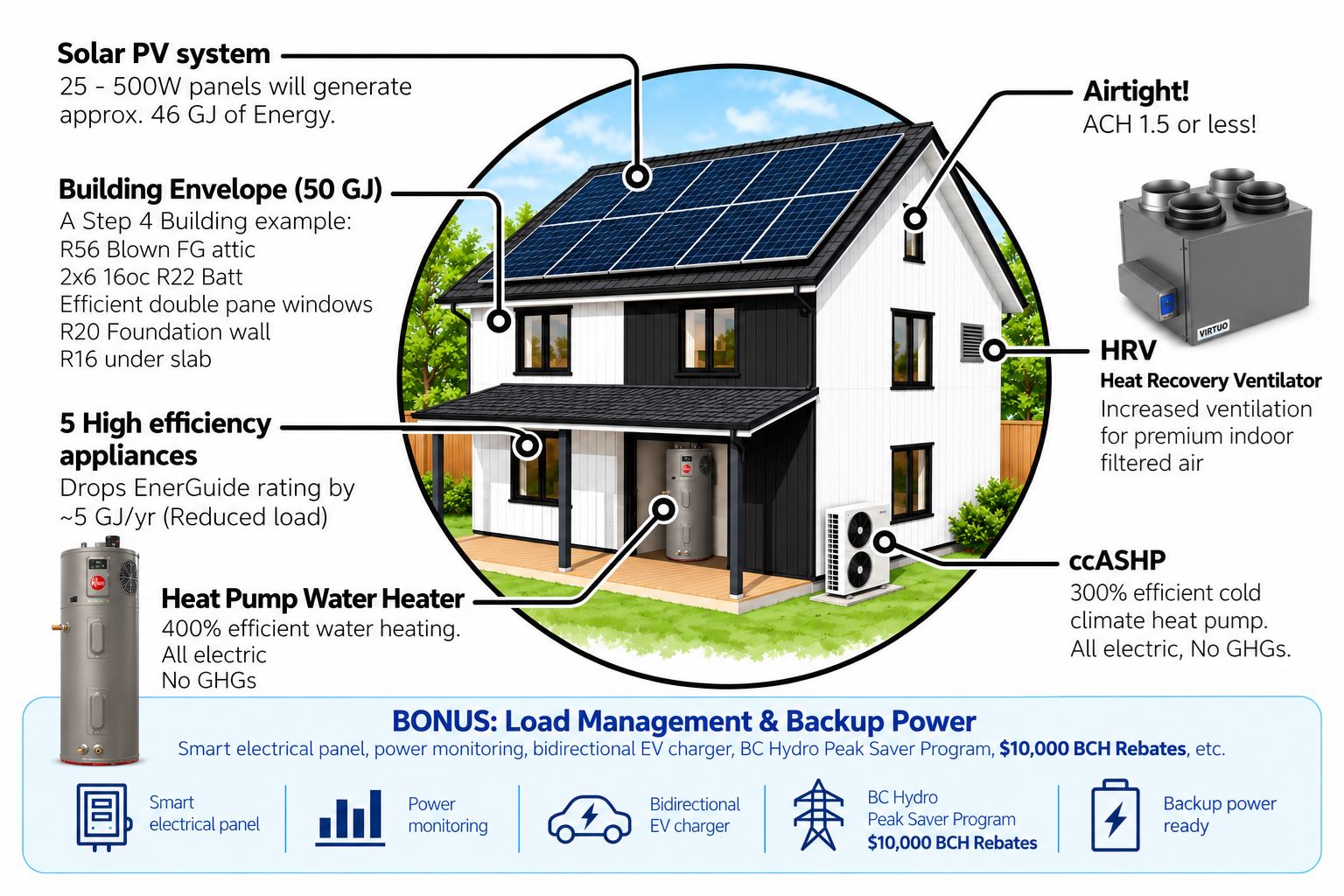
1Cut overall energy use
2Build to Step 4 or Step 5 performance
3Go electric on primary systems
4Size solar to the home
5Use smart load management
1
Cut overall energy use
The most cost-effective energy is the energy the home never needs. Before adding larger mechanical systems or more solar, start by lowering the home's baseline demand.
Design for efficiency
Use orientation, glazing, shading and floor-plan decisions to reduce unnecessary heating, cooling and lighting loads from the beginning.
Reduce air leakage
A tighter building envelope helps control heat loss, drafts and moisture while allowing ventilation to be handled intentionally.
Choose efficient devices
Lighting, appliances, plug loads and controls all add up. Lower device loads make every later Net Zero step easier.
Lower peak demand
Reducing simultaneous electrical demand can help avoid unnecessary service upgrades and makes smart load management more effective.
The goal: Create a home that needs less energy before deciding how to produce or manage that energy.
2
Build to Step 4 or Step 5 performance
High-performance construction combines insulation, airtightness, better windows and carefully designed mechanical systems into one coordinated building envelope.
Improve the thermal envelope
Use the right combination of above- and below-grade insulation to keep heat where it belongs and reduce seasonal energy loss.
Specify high-efficiency windows
Window performance has a major effect on comfort, heat loss and overheating. Better glazing improves both energy performance and occupant comfort.
Build tight, ventilate right
An airtight home should be paired with properly designed mechanical ventilation so fresh air is delivered without sacrificing efficiency.
Coordinate the systems
The envelope and mechanical design should be planned together so heating and cooling equipment is sized for the home's actual load.
The goal: Reduce heating and cooling demand enough that smaller, more efficient mechanical systems can do the job.
3
Go electric on primary systems
Once the home's energy demand is reduced, high-efficiency electric equipment can provide heating, cooling and hot water with much lower overall energy use.
Cold-climate heat pumps
Modern heat pumps can provide highly efficient heating and cooling while helping reduce reliance on combustion-based systems.
Heat-pump water heating
Water heating is a significant household load. Heat-pump water heaters can substantially reduce the electricity required for domestic hot water.
Efficient electric appliances
Induction cooking and high-efficiency appliances support an all-electric strategy while reducing the home's operating energy.
Right-size the equipment
Oversized equipment can reduce efficiency and comfort. Proper load calculations allow systems to be selected for the actual home.
The goal: Move the major home systems onto efficient electric technologies that can ultimately be supplied by clean electricity and solar.
4
Size solar to the home
Solar works best when it is designed around a home that is already efficient. The objective is not simply to install as many panels as possible, but to match generation to the home's expected annual energy demand.
Start with the energy model
Use the home's expected EnerGuide Rating and modeled annual consumption to estimate the solar production required.
Plan the roof early
Roof orientation, pitch, shading, plumbing vents and mechanical penetrations can all affect how much usable solar area is available.
Design for future loads
Consider EV charging, a future suite, hot tub, workshop or other expected electrical loads before finalizing system capacity.
Avoid oversizing the solution
A better-performing envelope generally means a smaller solar array is needed to reach the same Net Zero target.
The goal: Match renewable energy production to the home's real operating demand instead of using solar to compensate for avoidable inefficiency.
5
Smart Load Management
A high-performance all-electric home may contain several large electrical loads. Smart controls help those loads work together instead of all competing for power at the same time.
Manage major loads
EV charging, water heating, space conditioning and other equipment can be scheduled or controlled to reduce peak electrical demand.
Add battery storage where it makes sense
A home battery can store solar energy, shift consumption and provide backup capability depending on the system design.
Prepare for bidirectional EV charging
Vehicle-to-home technology has the potential to turn a compatible EV into a large mobile energy-storage resource for the house.
Design for resilience
Smart load management can prioritize essential circuits during an outage and help the home make better use of available stored energy.
The goal: Give the home the intelligence to balance comfort, electrical capacity, solar production, EV charging and backup power as one system.
Net Zero is the outcome of getting the whole system right.
Fluent Energy Consulting helps builders connect energy modelling, building-envelope decisions, mechanical design, electrification, solar readiness and load management early enough in the process to make the finished home simpler, more efficient and more cost-effective.